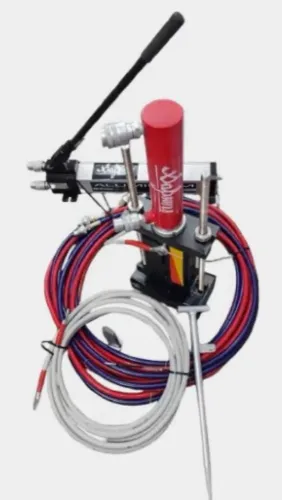

Sapsons Hydraulic Hand Pumps are heavy-duty industrial tools designed to create hydraulic pressure by hand. It is commonly used to operate hydraulic cylinders, jacks, pullers, and other hydraulic tools for applications such as lifting, pressing, jacking, and crimping, with maximum working pressures reaching 700 bar. These pumps are available in single and two-speed configurations and are noted for their robust construction and corrosion-resistant properties.
It works without electricity or air — only manual hand force is required.
How It Works
Oil (hydraulic fluid) is filled inside the pump.
When you move the handle up and down, it pushes the oil into a hydraulic cylinder.
The oil pressure creates force.
The force moves or lifts heavy loads.
Working Principle
A hydraulic hand pump works based on Pascal’s Law — pressure applied to a confined fluid is transmitted equally in all directions.
When the handle is pumped, the piston pushes hydraulic oil.
Oil pressure is generated inside the pump.
The pressurized oil flows to a hydraulic cylinder.
The cylinder ram moves and lifts or pushes the load.
A small manual force produces a large output force.
Available Pump Types
Portable Hand Pumps: Compact single or two-speed pumps designed for high performance where portability is a priority.
Heavy Duty Hand Pumps: Two-speed models featuring an automatic change-over system. They provide high oil discharge at low pressure and automatically switch to low discharge at high pressure once a load is reached.
High Flow Hydraulic Hand Pumps: These heavy-duty pumps feature a larger oil capacity and are specifically designed for use with double-acting cylinders and other larger equipment.
Key Specifications and Features
Sapsons designs these pumps to withstand high-pressure industrial environments using specific materials and safety features:
Max Pressure: Up to 700 bar (approx. 10,000 PSI) for heavy-duty models.
Safety Mechanisms: Built-in mechanisms to control pressure development and internal safety valves to prevent overloading.
Materials: Constructed from high-quality steel or cast iron; certain models use solid special alloy steel for components like crimping heads.
Oil Compatibility: Standard models are designed to use Grade 68 hydraulic oil.
Accessories: Typically supplied with or compatible with 2-meter-long hydraulic hoses tested for high burst strength.
Primary Applications
Crimping: Frequently paired with slim-design crimping heads (like the HP, SAP-MH, or HJ series) for aluminium and copper cable terminal ends up to 1200 sq. mm.
General Industrial: Widely used in manufacturing plants for jacking, bending, stretching, and dismantling operations.
Field Work: Portable models are specialized for electrical maintenance engineers and contractors who need to move tools between job sites.
Advantages
No electricity required
Ideal for field work
Portable and compact
Low maintenance
Cost-effective
Maintenance Tips
Check oil level regularly
Perform air bleeding if pressure is not building
Use clean hydraulic oil
Inspect seals for leakage
Store in a dry place
Keywords